
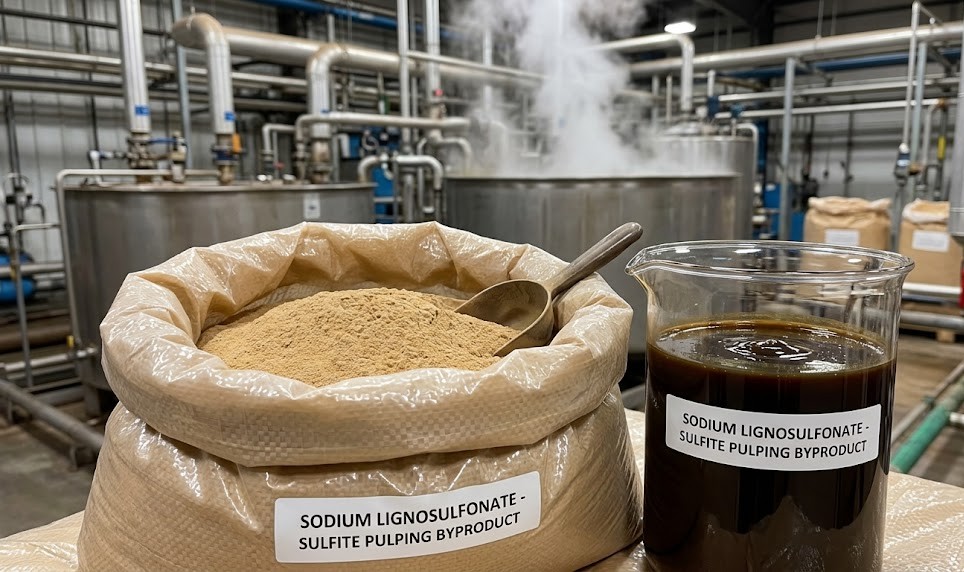
Sodium Lignosulfonate (CAS No. 8061-51-6) is a complex, water-soluble anionic polyelectrolyte. It is primarily derived as a highly valuable byproduct of the sulfite pulping process in the paper manufacturing industry.
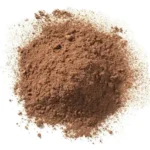
By upcycling the natural lignin that binds wood fibers together, manufacturers produce a versatile, brown, amorphous powder. Because of its unique amphiphilic properties (containing both water-attracting and water-repelling traits), it functions as a powerful dispersant, binder, and emulsifier across global heavy industries.
1. The Sulfite Pulping Process: How It Is Made
To understand the chemical behavior of Sodium Lignosulfonate, it is helpful to understand its origin in the 19th-century sulfite pulping process:
- Chemical Digestion: Raw wood chips (hardwood or softwood) are cooked in an aqueous solution of sulfurous acid (H₂SO₃) and sulfite salts (containing cations like Sodium, Calcium, or Magnesium).
- High-Heat Cooking: This mixture is processed under acidic-to-neutral conditions (pH 1.5–5.0) at temperatures of 130°C to 160°C for 4 to 14 hours.
- Sulfonation (Lignin Separation): The cooking process breaks down the wood. The lignin—the natural polymer that glues the wood fibers together—undergoes sulfonation. This introduces hydrophilic (water-loving) sulfonic acid groups, making the previously insoluble lignin dissolve into a dark liquid known as “spent sulfite liquor.”
- Extraction: The solid cellulose fibers are removed to make paper. The leftover liquor (which contains 50% to 60% lignosulfonates) is filtered, purified, and spray-dried into a concentrated powder or liquid.
2. Chemical and Physical Properties
Because it is a natural plant derivative, Sodium Lignosulfonate is a polydisperse polymer—meaning its molecular size and exact structure vary depending on the wood species used (e.g., pine vs. eucalyptus).
| Property | Technical Specification | Operational Impact |
| Typical Formula | C₂₀H₂₄Na₂O₁₀S₂ | Imparts strong anionic (negative) charges for electrostatic particle repulsion. |
| Molecular Weight | 1,000 – 140,000 Daltons (Da) | Heavier molecules provide better dispersion; lighter molecules offer faster solubility. |
| Sulfur Content | 3% – 8% by weight | Distinguishes it from Kraft lignin (which has zero sulfur); enables unique binding capabilities. |
| Water Solubility | Up to 500 g/L (at neutral pH) | Highly soluble, making it easy to formulate into liquid industrial solutions. |
| Thermal Stability | Stable up to 200°C (392°F) | Ideal for high-heat manufacturing environments like oil drilling or ceramics. |
3. Global Industrial Applications
Thanks to its low cost, high thermal stability, and 100% biodegradability, Sodium Lignosulfonate is utilized across four primary sectors:
Heavy Construction
- Concrete Admixtures: Acts as a superplasticizer. It disperses cement particles, improving the liquid flow of the concrete while reducing the required water content by 10% to 15%. This directly increases the compressive strength of the cured structure.
- Cement and Gypsum: Functions as a grinding aid in cement kilns and a set-retarder in the manufacturing of gypsum drywall boards.
Agriculture and Animal Feed
- Feed Binder: Used to glue pelleted animal feed together, drastically improving pellet durability and reducing powdery feed dust.
- Soil Conditioner: Enhances soil structure and water retention, particularly in arid farming regions.
- Pesticide Dispersant: Stabilizes liquid agricultural chemicals, ensuring uniform crop spraying.
Industrial Manufacturing
- Chemical Dispersant: Prevents particles from clumping in commercial dyes, printing inks, and carbon black formulations.
- Oil & Gas Drilling: Thins out heavy drilling muds, improving fluid flow under extreme high-temperature and high-pressure (HTHP) underground conditions.
- Refractory Binder: Increases the “green strength” (pre-firing durability) of ceramics and iron ore pellets.
Environmental Management
- Dust Suppression: Sprayed onto unpaved mining haul roads to permanently bind loose dirt, eliminating hazardous airborne dust.
- Water Treatment: Acts as a flocculant in wastewater facilities, helping to clump and remove suspended toxic solids.
4. Business Advantages vs. Market Challenges
When evaluating Sodium Lignosulfonate for procurement or engineering, it is important to weigh its natural benefits against its supply-chain realities:
| Strategic Advantages | Operational & Market Challenges |
| Cost-Effective: Highly abundant and cheap to produce, typically costing only $200 to $500 per Metric Ton. | Batch Variability: Because it comes from natural wood, molecular weight and performance can vary slightly between different supplier batches. |
| Eco-Friendly: Fully biodegradable and non-toxic; supports the circular economy by repurposing industrial waste. | High Sulfur Content: The 3% to 8% sulfur content creates an odor and limits its use in high-purity or sulfur-sensitive electronics manufacturing. |
| Highly Versatile: Tunable properties allow it to be custom-formulated for dozens of different heavy industries. | Declining Supply Source: As the paper industry shifts away from sulfite pulping toward Kraft pulping, future global supplies may tighten, potentially increasing costs. |