
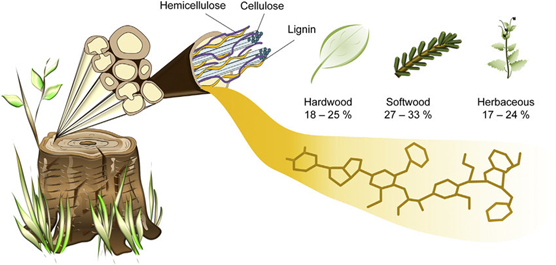
Lignin is a heterogeneous aromatic biopolymer found in the cell walls of wood and other vascular plants. Its structure and properties vary with biomass source, pulping or biorefinery process, isolation method and subsequent modification. Lignin is not the same as lignosulfonate: lignosulfonates are sulfonated lignin-derived materials with substantially different water and charge behavior.
This ChinaLignin page is retained temporarily because it has existing search visibility. The complete neutral guide is now maintained at About Lignin: Sources, Structure, Properties and Industrial Use.
Main industrial lignin streams
| Source/process | Typical material | Important distinction |
|---|---|---|
| Kraft pulping | Kraft lignin recovered from alkaline black liquor | Usually requires isolation and may require modification for neutral-water compatibility |
| Sulfite pulping | Lignosulfonates in spent sulfite liquor | Sulfonate functionality develops during pulping |
| Soda pulping | Soda lignin | Properties depend strongly on feedstock and recovery |
| Biorefinery/organosolv routes | Process-specific lignin fractions | Solvent and pretreatment history affect purity, reactivity and molecular distribution |
Sulfonation and sulfomethylation
Technical lignins may be chemically modified to increase sulfonate functionality and water compatibility. Sulfonation and sulfomethylation are not interchangeable labels, and product performance depends on molecular distribution, charge density, degree of sulfonation, residual reagents and end-use conditions.
The former version of this page closely followed the review by Aro and Fatehi, “Production and Application of Lignosulfonates and Sulfonated Lignin,” ChemSusChem (2017). The review discusses sulfite-derived lignosulfonates, modified kraft lignin, sulfonation/sulfomethylation and application relationships.
Published historical data
| Reported figure | Evidence/status | Correct interpretation |
|---|---|---|
| Lignin content of woody biomass: 15–40 wt% | Literature-reported category range cited in the 2017 review | Varies by species, tissue and analytical method; not a product specification |
| Technical lignin generated annually: 50–70 million tonnes | Historical literature estimate discussed in the 2017 review | Not current market data; year, process boundary and recovery definition must be considered |
| Only 1–2% used for value-added products | Historical literature estimate associated with the same production discussion | Not a current utilization rate or Green Agrochem sustainability claim |
These figures are retained because they help explain the historical motivation for lignin valorization. They should not be quoted as current market facts without an updated, directly verified dataset.
Why properties vary
- softwood, hardwood and non-wood feedstocks have different structural-unit distributions;
- pulping chemistry changes molecular size and functional groups;
- isolation and washing affect ash, salts and residual carbohydrates;
- fractionation changes molecular distribution and purity;
- oxidation, sulfonation and other modifications change charge and solubility;
- pH, temperature, water hardness and substrate control application behavior.
Application and division routes
- Neutral lignin knowledge guide for chemistry, sources and industrial-lignin comparisons.
- Sulfonated lignin from kraft black liquor for process and modification context.
- ChinaLignin agriculture division for fertilizer, micronutrient, soil and crop formulation intent.
- LigninCorp industrial division for industrial-grade products and procurement.
Frequently asked questions
Is lignin one chemical?
No. It is a family of heterogeneous polymers whose composition depends on biomass and processing.
Is lignin automatically water soluble?
No. Water behavior depends on the lignin type, functional groups, pH and modification. Lignosulfonates are generally more water compatible because of sulfonate functionality.
Are the historical production figures current?
No. They are retained as literature-reported historical estimates and require updated sourcing before use as present-day market data.
Where should buyers evaluate industrial lignin products?
Use the neutral knowledge site for technical comparison, then contact the appropriate agriculture, animal-nutrition or industrial division for an exact grade and current documentation.