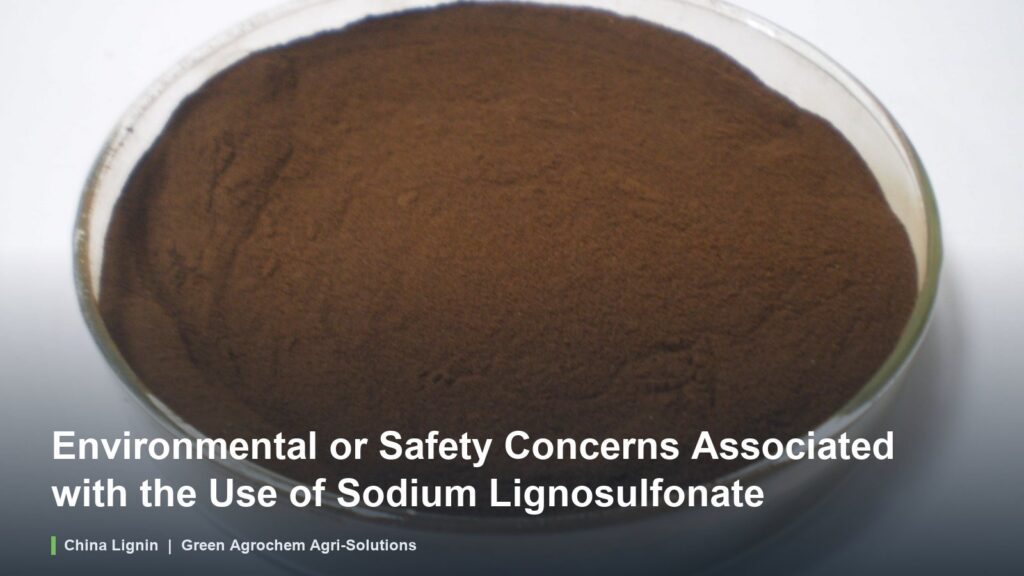
Sodium lignosulfonate environmental and handling claims should be tied to an identified grade, current supplier documents and relevant test evidence. Renewable feedstock alone does not establish a degradation rate, an ecological benefit, unrestricted use or a universal hazard classification. This guide helps agricultural formulators distinguish documented reference properties from claims that still require verification.
Start with the exact grade and document revision
The product example below is Green Agrochem Sodium Lignosulfonate — Agri Grade, product code GAC-NaLS-Agri. The reviewed documents are TDS GAC-NaLS-Agri, Rev. 2.0, and MSDS GAC-NaLS-Agri-MSDS, Rev. 2.0. They do not establish the properties of every sodium lignosulfonate, liquid grade or finished fertilizer formulation. Request the current documents and shipment COA through the agricultural sodium lignosulfonate product page.
Documented agricultural-grade reference data
Evidence class: supplier TDS reference values, not a binding universal specification. The TDS labels its table as typical production results and directs buyers to the shipment COA. The limit wording below is reproduced as listed in that document.
| Parameter | GAC-NaLS-Agri TDS Rev. 2.0 |
|---|---|
| Appearance | Yellow-brown powder |
| pH | 7.0–9.5 |
| Dry matter | 95% min |
| Water-insoluble matter | 1% max |
| Sulphate | 2–5% |
| Calcium and magnesium | 0.5% max |
| Lignosulphonate content | 55% min |
| Reducing sugar | 7% max |
| Moisture | 5% max |
The reviewed TDS does not state the pH test concentration or temperature. It also lists dry matter and moisture separately without their test methods. Ask the technical team to clarify these bases before making contractual comparisons; do not infer a corrected moisture limit or assume the two tests are exact complements. Lignosulphonate content is not equivalent to a generic claim of chemical purity.
Biodegradability: require a test, not a percentage alone
The Agri Grade MSDS describes expected biodegradability but provides no measured degradation percentage, test duration or study report. This does not verify the former claim of more than 96% degradation, nor does it establish ready biodegradability under a particular method.
External method context, not a product result: OECD Test No. 301: Ready Biodegradability describes aerobic aqueous screening methods, normally run for 28 days. Its summary gives pass levels of 70% dissolved organic carbon removal or 60% of theoretical oxygen demand/carbon dioxide production for the relevant methods, with timing criteria. These are method criteria, not measured results for Green Agrochem material. Interpretation requires the applicable method, substance characterization, controls and complete report.
Agricultural and environmental qualification
The reviewed MSDS explicitly states that product-specific aquatic toxicity data are unavailable. Its general expectations about environmental behavior must not be restated as proof of zero aquatic risk, no bioavailability or no bioaccumulation under every condition. Review the proposed use, concentration, receiving environment and available test data with the responsible technical team.
For a fertilizer or soil formulation, assess compatibility, soluble-salt contribution and the intended application separately from handling classification. Crop response, soil improvement, aluminum interaction and carbon-sequestration claims need relevant formulation and field evidence; none follows automatically from the product name. Production and formulation variables are discussed in how lignosulfonate production affects agricultural quality.
Handling information must remain grade-specific
Sections 2, 7 and 8 of the reviewed Agri Grade MSDS describe possible dust or mist irritation, ventilation, protective eyewear and gloves, and exposure-dependent respiratory protection. Use the current SDS and a workplace exposure assessment to select controls. This article does not prescribe a universal respirator class or replace operating procedures, training or emergency instructions.
The MSDS does not give a 230°C flash point or a 250°C safe operating limit. It warns about excessive heat and incompatible materials. Its classification language is based on available information and its regulatory section requires destination-specific verification. Do not convert that wording into an unconditional claim that every grade is nonhazardous, harmless if swallowed or suitable for unrestricted discharge.
Earlier numerical claims retained for traceability
The following are unverified legacy claims, not current product specifications, recommended use levels or safety limits. Do not use them for procurement or process design.
| Former statement | Current evidence status |
|---|---|
| More than 96% aerobic degradation | No supporting grade-specific study was identified in the reviewed documents. |
| 98–99% purity; minimum 98% | Not established for GAC-NaLS-Agri. Its TDS reports lignosulphonate content separately. |
| Moisture maximum 5% | Not the moisture value in the reviewed Agri Grade TDS; see the documented table and basis caveat above. |
| Flash point around 230°C | Not supported by the reviewed MSDS; not an operating or fire-safety limit. |
| Stable up to 250°C | No supporting stability test or exposure conditions were supplied. |
| pH 7.0–9.5 in a 1% solution | The range appears in the TDS, but the 1% test concentration is not specified there. |
| P1 particulate filter recommendation | Do not apply as a universal selection rule; use the current SDS and workplace assessment. |
Documents to request before approval
- Exact grade, physical form and current TDS/MSDS revisions.
- Shipment COA, analytical methods and agreed acceptance limits.
- Full environmental study reports supporting any quantitative claims.
- Application testing for the complete agricultural formulation.
- Destination-market review of the intended use and required documentation.
For document clarification, contact info@greenagrochem.com with the grade, application and destination. Industrial buyers can use the industrial sodium lignosulfonate product route.
Sources reviewed: Green Agrochem GAC-NaLS-Agri TDS Rev. 2.0; GAC-NaLS-Agri-MSDS Rev. 2.0, especially Sections 2 and 7–16; OECD Test No. 301 (1992). Review date: 2 October 2026. Supplier documents are available on request; their stated limitations and the actual supplied grade control.