
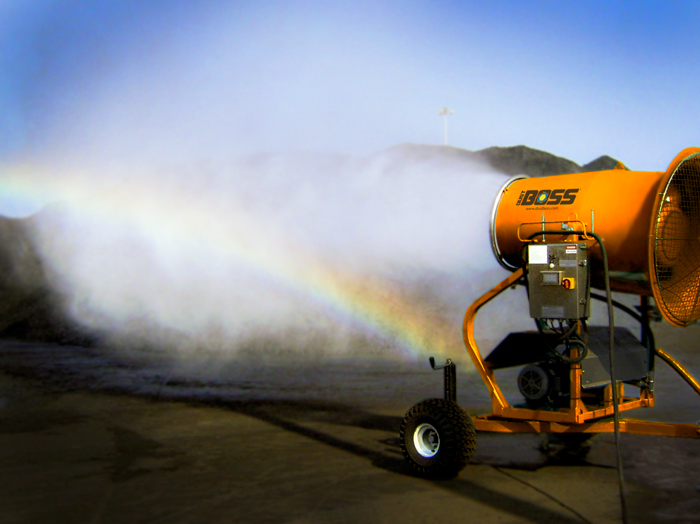
Sodium lignosulfonate may be evaluated as a water-soluble binder for fugitive-dust control on compatible unpaved roads, mine and quarry routes, construction access roads, and selected bulk-material working areas. It is not a universal substitute for road design, drainage, grading, traffic management, or site-specific environmental controls.
This page preserves a concise technical overview for readers researching sodium lignosulfonate dust control. Detailed industrial grade selection, field-trial design, application planning, and procurement guidance are maintained by Green Agrochem’s Industrial Chemicals division in the Sodium Lignosulfonate for Dust Suppression: Selection & Field Trials guide.
How dust suppression may work
When a prepared aqueous solution is distributed through a suitable wearing course, it wets mineral fines and can contribute cohesion as water is lost. This may reduce the tendency of fine particles to become airborne under traffic or material handling. The result should be treated as a maintained surface layer, not as permanent paving. Rainfall, abrasion, grading, fresh aggregate, drainage defects, and traffic progressively change the treated surface.
Where the product may be evaluated
- Mine, quarry, and industrial haul roads: evaluate dust reduction together with rutting, corrugation, surface loss, skid condition, and maintenance frequency.
- Construction and industrial access roads: consider only after correcting drainage, potholes, crossfall, and inconsistent aggregate distribution.
- Aggregate and bulk-solid working areas: assess overspray, runoff, tracked material, equipment exposure, and the effect of routine site cleaning.
- Rural or forestry routes: review local watercourse setbacks, soil sensitivity, traffic pattern, rainfall, and permit requirements before use.
Very coarse surfaces with insufficient fines, highly plastic clay, poorly drained ground, concentrated runoff paths, and locations with restrictive discharge requirements may be unsuitable or require a different treatment strategy.
Variables that control field performance
Performance depends on more than the product name. Important variables include the exact lignosulfonate grade, as-supplied solids or powder moisture, solution preparation, aggregate grading, fines content, initial moisture, surface preparation, spray calibration, application sequence, curing conditions, traffic loading, rainfall, temperature, and maintenance practice. Sodium, calcium, and magnesium lignosulfonate grades should not be assumed interchangeable without comparative testing.
Before a trial, review the current TDS, SDS, and lot-specific COA for the exact product. Relevant items may include product identity, solids or moisture basis, pH test method, insoluble matter, liquid density, powder dissolution behavior, storage conditions, and any impurity limits required by the site.
No universal concentration, coverage, or service life
A fixed solution concentration, application rate, coverage figure, or number of months of effectiveness cannot be recommended without an identified product document and field evidence. Adding the word “recommended” does not validate an unsupported number. Any supplier-recommended starting trial range must identify the exact grade and document revision and state whether the basis is as-supplied product, dry solids, treated area, or treated material mass.
Recommended qualification approach
- Characterize aggregate grading, fines, moisture, drainage, road geometry, traffic, weather exposure, and existing defects.
- Keep an untreated or current-practice control section exposed to comparable traffic.
- Prepare controlled trial sections using calibrated equipment and clearly documented addition bases.
- Record wetting, penetration, runoff, surface pickup, curing, visible dust, surface loss, rutting, corrugation, and maintenance events.
- Review results after representative traffic and weather events, then define action limits for repair, grading, or reapplication.
- Confirm the selected procedure at controlled operating scale before routine adoption.
Published agency guidance: application basis and field control
The figures below come from public agency guidance for the stated road-treatment conditions. They are not Green Agrochem product specifications, universal recommended dosages or guaranteed service-life results.
| Reported guidance | Road or treatment system | Conditions and basis | Source | How to interpret it |
|---|---|---|---|---|
| 50% residual solution applied at 0.50 gal/yd² to deliver a 25% residual | Construction roadway dust control using commercially available lignosulfonate with known lignin content | Loosen the top 1–2 inches, apply uniformly, allow penetration and tight-blade the surface; diluted products require an equivalent residual delivery | Iowa DOT Section 9040, Dust Control | This is a specification example tied to its residual-content and surface-preparation basis—not a general product dosage. |
| Initial chemical application is typically divided into three passes; a later light application may represent about 15–20% of the total rate | Chemically treated unpaved roads | Road shaping, moisture conditioning, calibrated spray-bar application, penetration and compaction are required; rate depends on material, traffic and climate | FHWA Gravel Roads Construction and Maintenance Guide, Chapter 6 | The split is process guidance. The total application rate must still come from the selected supplier and a project test section. |
| Dust-control mix-in depth is typically 1–2 inches (25–50 mm); final sealing application may be about 25% of the total application rate | Mix-in dust-abatement treatment on unpaved roads | Control moisture near optimum, mixing depth, distribution and compaction; deeper soil-stabilization treatments use a different basis | FHWA Gravel Roads Construction and Maintenance Guide, Chapter 6 | Depth and split describe construction practice, not a universal lignosulfonate concentration or coverage rate. |
Application rule: use the current supplier recommendation for the exact product concentration and define whether the rate is based on as-supplied liquid, dry solids, treated area or treated aggregate mass. Confirm the rate on a representative test section using the actual road material, fines content, moisture, traffic, rainfall, drainage, equipment and acceptance method.
The former generic claims of 5–20% solution concentration, 100–300 gal/acre coverage and two-to-six-month service life are not reinstated as universal values. They remain unverified until an exact product document or defined field record supplies the missing grade, solids basis, surface condition, application method, traffic and climate.
Safety and environmental boundaries
Do not approve a grade or field procedure from generic claims such as “non-toxic,” “environmentally friendly,” “biodegradable,” or “effective in all soils and weather.” Review the current SDS, local discharge rules, worker exposure controls, watercourse and groundwater sensitivity, storage and spill procedures, and any permit-specific conditions. Prevent concentrated product and uncontrolled runoff from entering drains or surface water.
Technical and purchasing routes
For neutral background reading, see the lignosulfonate dust-control technical guide. Industrial buyers can review the LigninCorp sodium lignosulfonate product page and send the surface description, climate, traffic, available equipment, required documents, and target test method to info@greenagrochem.com.