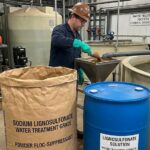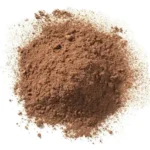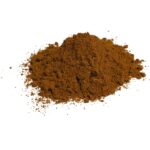

The lignosulfonates are long explored waste or by-products of the pulp and paper making industry. Similar in many ways to tannins, many have studied and researched ways to use them in tanning. In the past they have been found only minimally useful as fillers, coloring (poor) agents, etc., but never as tanning agents.
However, one must now stop and consider the changes in tanning information and look at the phenolic character as well as the molecular size of these compounds which may under just the right conditions lend them to a new combination tannage that really could be useful.
Since they are natural materials that would be bio-degradable. They have large molecular weights on the order of tannin compounds. They have active phenolic character, though much less than most tannins. They produce a brown color similar to tannins and have many common chemical and physical characteristic like tannins.
They are available in huge quantities at very reasonable prices. On the other hand, many of the best minds in the industry have tried for decades to use them. use 2%-3% Lignosulfonate during pretanning process(before adding Chrome or vegetable tannin)is to increase the tan’s penetration time and uptake into hide and shortens the tanning time.
Tanning with lignosulphonates
Lignosulphonate can be applied in all tanning processes in which vegetable tannins ar e used, including pure vegetable or combination tanning.
Except in pretanning, lignosulfonate should always be used in conjunction with vegetable tannins. lignosulfonate can be used with all vegetable tannins, but the best results are achieved with the catechu tannins e.g. Mimosa, Quebracho etc.
Because of its effect of dissolving the phlobaphenes (bark tanning substances) lignosulfonate results in an almost sludge free tanning liquid.
—CLEANER TANNING LIQUID RESIDUE
lignosulfonate accelerates the diffusion of the vegetable tannins into the skin substance while simultaneously increasing the absorption capacity thereby shortening the tanning process.
—SHORTER PRODUCTION TIME
The use of lignosulfonate permits tanning at a lower pH-count without
the risk of grain hardening, thus giving the leather a brighter colour.
—BETTER OPTICAL RESULTS
Furthermore because lignosulfonate binds irreversibly with the skin substances, it cannot be displaced by the vegetable tannins, which results in a higher processed leather yield per quantity of tanning liquid used.
—MORE ECONOMICAL
lignosulfonate is almost lime and iron free. The ash content is negligible. —minmises NEGATIVE EFFECTS ON LEATHER QUALITY
lignosulfonate is an excellent iron sequestering agent as the iron complex is bound by the lignosulphon acids. This prevents the discoloration caused by iron.
—REDUCTION OF IRON DAMAGE
lignosulfonate is used by tanneries in the following ways: 一 as admixture in vegetable tan liquor 一 as pretanning agent 一 as charger agent 一 for the retanning of chrome leather
- LIGTAN mixed with vegetable tanning extracts
(Soles, quick tanned sole leather, upper, etc.)
lignosulfonate is applied in combination with vegetable tannins in all the stages of the various tanning process systems and replaces a significant proportion of those vegetable tannins. The most efficient proportion of LIGTAN tannins depends on the quality of the tanning agent being used; however, in the case of the astringent tannin types, like Quebracho and Mimosa, up to 25% ALF can be added. In the case of less astringent agents a smaller percentage of between 15 and 20% is recommended.
Starting with a proportion of 5 – 10%, we recommend that the amount is gradually increased in the course of the process. To achieve the most efficient absorbtion of lignosulfonate by the skin substance it is important that the pH-count is kept low; 3.3 – 4.3 pH is recommended for the colouring process while ap proximately 3.5 is recommended for the submersion. These values can vary in specific productions and must be adapted accordingly. Working with lower pH-counts brings correspondingly better results.
It is best to mix lignosulfonate with the vegetable tanning mixture during the extraction process. Because of the excellent effectiveness of lignosulfonate on the tannins in the bark layer, the amount of sodium bisulphite normally used can be significantly reduced and eventuelly left out altogether.
The remarkable property of lignosulfonate to absorb ion reduces the danger of colour quality loss which can be caused by the iron content in the tanning liquids.
The following experiment was carried out by the Technological Institute of Copenhagen and demonstrates that lignosulfonate benneficially influences the absorption of the tanning agents by the skin substances.