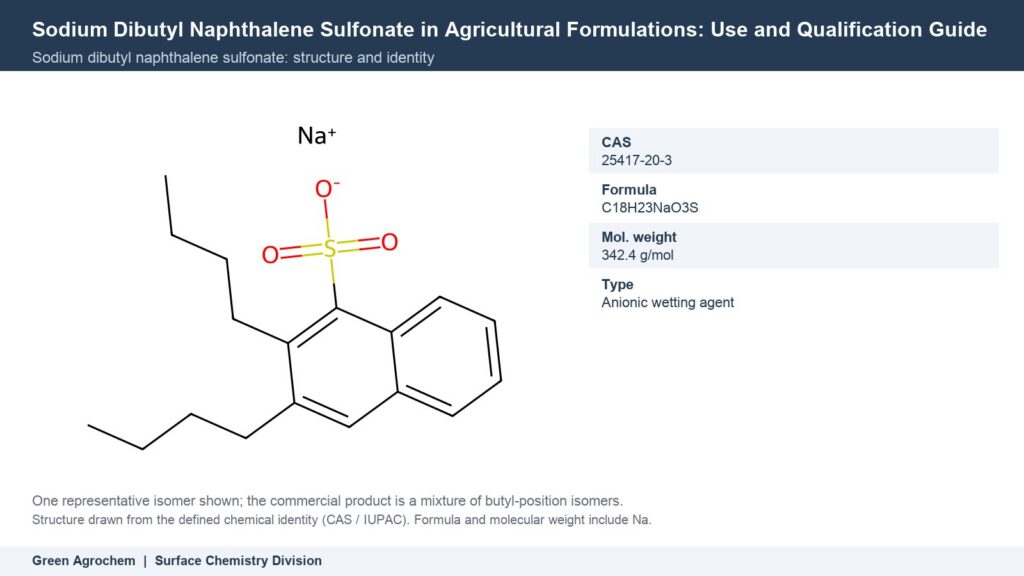
Sodium dibutyl naphthalene sulfonate is an anionic surfactant that may be evaluated as a wetting or processing aid in selected agricultural formulations. Its suitability depends on the exact commercial grade, active ingredient, formulation type, carrier, water chemistry, other surfactants and required finished-product tests. It is not a pesticidal active ingredient and should not be described as a universal dispersant or emulsifier.
This ChinaLignin page is retained as an agriculture-focused qualification overview because it already serves crop-formulation search intent. Exact product specifications, samples and procurement belong to the GreenAgrochem.net sodium dibutyl naphthalene sulfonate product page.
Define the required formulation function
| Possible function | Useful measurements | Qualification boundary |
|---|---|---|
| Powder wetting | Wetting time, floating material, dispersion after standardized agitation. | Test the actual active, filler and water; do not infer performance from solubility. |
| Leaf-surface wetting | Surface tension, contact angle, droplet spread, coverage and runoff. | Results depend on crop surface, nozzle, water and the complete adjuvant package. |
| Penetration or rapid soaking | Substrate-specific penetration time and deposit behaviour. | Physical penetration does not establish biological uptake or efficacy. |
| Processing support | Mixing, filtration, foam, granulation and equipment cleanliness. | Plant-scale behaviour must be verified after laboratory screening. |
| Emulsion or suspension assistance | Phase separation, particle size, viscosity, settling and redispersibility. | The product may need complementary emulsifiers or dispersants. |
Agricultural formulation systems
Wettable powders and water-dispersible granules
In WP and WDG systems, a candidate grade may help water reach hydrophobic powder surfaces during dilution. Test wetting time, suspensibility, persistent foam, sieve residue, particle-size distribution and redispersion using the actual active ingredient and fillers. In WDG development, also measure granule strength, attrition, disintegration and the effect of the full binder/dispersant package.
Suspension concentrates
For SC formulations, wetting is only one requirement. Long-term physical stability normally depends on the dispersant, rheology modifier, antifreeze, antifoam, preservative and milling process. Check viscosity at defined shear, particle-size stability, sediment hardness, redispersibility and temperature-cycle behaviour. Do not treat this surfactant as a complete SC stabilization system without evidence.
Soluble liquids and foliar nutrient systems
In soluble or nutrient-containing liquids, verify clarity, precipitation, foam and interaction with salts or metal ions. Leaf coverage and crop safety require separate testing. Improved spreading does not automatically prove nutrient absorption, rainfastness or crop response.
Emulsifiable and oil-containing systems
An anionic wetting agent may contribute to a broader emulsifier package, but it should not be assumed to stabilize every oil or solvent system. Determine the required HLB behaviour and evaluate emulsion spontaneity, cream, oil separation and dilution stability across relevant water hardness and temperature conditions. Use a complete, formulation-specific surfactant package.
Exact-grade documentation
- Current TDS and SDS identifying the commercial grade and revision.
- Representative COA with active matter or solids, pH, moisture, inorganic salts and other applicable limits.
- Clear test methods and calculation bases for every specification.
- Product form, packaging, storage, shelf life and transport information.
- Destination-market regulatory documentation and supplier change-control policy.
Do not publish a single molecular formula, molecular weight, colour, active content or impurity profile as universally applicable when the marketed material may be an isomer distribution, mixture or grade-specific composition. Use the current supplier documents for the exact product.
Water and tank-mix compatibility
- Record water hardness, pH, bicarbonate, temperature and visible solids.
- Follow the proposed order of addition and mixing intensity.
- Include the complete active, carrier, surfactant, antifoam and salt system.
- Observe precipitation, phase separation, foam and heat generation immediately.
- Recheck after the intended operational hold period.
- Pass the mixture through the intended screens and nozzles.
- Complete storage and temperature-cycle testing for formulated products.
Do not claim universal hard-water tolerance or broad tank-mix compatibility. Water composition and formulation chemistry can change wetting, foam, precipitation and stability. A jar test is an initial screen, not evidence of field efficacy or crop safety.
Dosage and performance claims
There is no universal addition level for sodium dibutyl naphthalene sulfonate in agricultural formulations. A numerical range may be used only when supported by a current technical document for the exact grade and when the basis is defined—for example, as-supplied product, active matter, total formulation or final spray volume. It must be described as a supplier-recommended starting trial range and optimized through actual-formulation testing.
Do not claim automatic improvement in pesticide efficacy, penetration, adhesion, rainfastness, active-life extension, reduced use rate or crop yield. Physical wetting results and biological performance are different evidence categories and require different controls and methods.
Safety, environmental and regulatory limits
Wood-derived chemistry is not relevant to this synthetic naphthalene-sulfonate surfactant. Do not describe the product as automatically biodegradable, low-toxicity, organic-compatible or environmentally safe. Review the current SDS, ecotoxicology and market-specific formulation regulations for the exact grade and intended use. Registered pesticide labels and local adjuvant rules take priority over generic formulation guidance.
Qualification workflow
- Define one required wetting or processing function.
- Select an exact grade using current documents.
- Screen it against the existing system and a relevant benchmark.
- Measure the specified physical properties after fresh and aged storage.
- Verify crop safety and efficacy separately where the end use requires them.
- Confirm process behaviour at pilot or production scale.
- Freeze the approved grade, dosage basis, specification and change-control requirements.
Technical and commercial resources
- Product and sample request
- Technical-grade specification guide
- Emulsification-aid qualification guide
- Price and RFQ guide
- Lignosulfonate foliar-adjuvant overview
For grade selection, provide the formulation type, active ingredient, fillers or oil phase, water analysis, process, destination market and acceptance tests to info@greenagrochem.com.