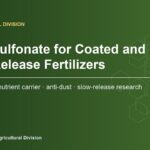

Lignosulfonate and other lignin derivatives are used in fertiliser coatings as binders, conditioning agents and, in research, as components of slow-release coatings. In commercial practice lignosulfonate mainly helps coatings stick and reduces dust and caking; lignin-based controlled-release coatings for urea are an active research area with promising but still limited field evidence.
Roles of Lignosulfonate in Fertiliser Granules
| Role | How it works | Status |
|---|---|---|
| Granulation binder | Dissolved lignosulfonate bridges particles during granulation and drying | Established industrial use |
| Coating carrier for micronutrients | Lignosulfonate solution carries Zn, Mn, Fe or B onto NPK or urea granules | Established; check compatibility and drying |
| Anti-dust and conditioning | Thin film reduces dust and abrasion | Used; effect depends on coating level |
| Slow-release coating component | Lignin or modified lignin in a polymer film slows water entry and nutrient release | Research and development; limited commercial use |
What Research on Lignin Coatings Reports
- A 2016 study coated urea with acetylated lignin from kraft and sulfite black liquor. Seven-day nitrogen release in soil was reported at 36.3% (kraft lignin) and 45.3% (sulfite lignin), compared with 59% for sulfur-coated urea (Behin and Sadeghi, 2016).
- A 2024 mini review describes lignin composites with starch, cellulose, chitosan and alginate as coating materials that can improve mechanical strength and release control (Jurnal Teknologi Industri Pertanian, 2024).
- Release from any coating depends on coating thickness and completeness, soil moisture and temperature, which is why a seven-day dissolution or release test is often used to compare coatings.
These are laboratory and pilot results. Field performance depends on soil, climate and crop, so claims about nitrogen-use efficiency or yield should come from local trials.
Practical Points for Formulators
- Choose the cation. Ammonium lignosulfonate adds nitrogen; potassium lignosulfonate adds K2O; calcium lignosulfonate adds calcium. Sodium grades add sodium, which is unwanted in some soils.
- Control moisture. Lignosulfonate solutions add water; granules must be dried back to their moisture specification to avoid caking.
- Check urea compatibility. Test for caking and hardness changes during storage.
- Measure release. Use a water-dissolution test (for example nitrogen released at 24 h and 7 days at 25 °C) on coated and uncoated granules.
- Label carefully. In the EU, “slow release” and “coated” claims for fertilising products have specific requirements under Regulation (EU) 2019/1009.
Frequently Asked Questions
Can lignosulfonate make urea slow-release?
Lignosulfonate on its own is water-soluble and mainly acts as a binder or carrier. Slow release requires a water-resistant coating; lignin and modified lignin are being researched as components of such coatings.
Why add lignosulfonate to fertiliser granules?
To bind particles during granulation, carry micronutrients onto granules and reduce dust. Ammonium and potassium grades also add N or K.
How is release from coated fertiliser measured?
Usually with a water or soil incubation test measuring the share of nutrient released over time, for example at 24 hours and 7 days.
References
- Behin J., Sadeghi N., urea coated with acetylated lignin from kraft and sulfite black liquor (2016)
- Mini review: controlled/slow-release fertiliser coatings from polysaccharides with lignin as reinforcement, Jurnal Teknologi Industri Pertanian (2024)
- Regulation (EU) 2019/1009 on EU fertilising products (PFC 1(C)(II) micronutrient fertilisers; CMC 1 chelating and complexing agents)
Related Pages
- Ammonium lignosulfonate
- Calcium lignosulfonate (agricultural)
- Calcium lignosulfonate for fertiliser granulation
Questions about a specification, a test method or a trial: contact us or email info@greenagrochem.com.