
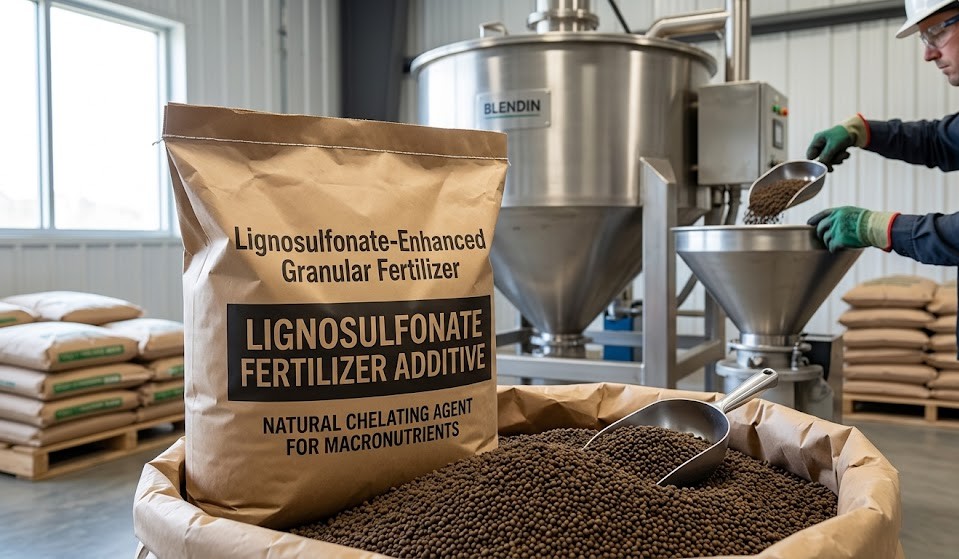
Lignosulfonates are used in fertilizer manufacturing mainly as formulation and processing aids—not as a universal fertilizer category. Depending on the exact grade and finished-product design, they may be evaluated for granulation, binding, dispersion, mineral or micronutrient complexation, liquid-formulation handling, and selected soil-applied products. The salt name alone does not prove nutrient value, chelation status, regulatory eligibility, or agronomic performance.
Why grade identity matters
Commercial lignosulfonates are heterogeneous lignin-derived materials whose properties vary with wood feedstock, sulfite-pulping chemistry, purification, concentration, counter-ion, drying, and post-treatment. Sodium, calcium, magnesium, ammonium, potassium, or micronutrient-containing products should not be treated as interchangeable. Buyers must qualify the exact supplier grade through a current TDS, SDS, lot-specific COA, sample, and agreed test methods.
Terms such as “fertilizer grade,” “agricultural grade,” “complexed,” “chelated,” “organic,” or “slow release” require defined composition and market-specific support. A counter-ion appearing in the product name is not enough to establish a nutrient claim or finished-product registration.
Main functions in fertilizer production
Granulation and binding
A compatible lignosulfonate grade can be screened as a binder or granulation aid in selected mineral, organomineral, and compound fertilizer processes. Evaluation should cover liquid or powder feeding, wet mass behavior, granule-size distribution, recycle load, green strength, drying demand, attrition, dust, caking, and storage stability. Performance varies with raw-material surface chemistry, moisture, equipment, temperature, drying profile, and coating system.
Dispersion and suspension control
In liquid or suspension fertilizers, lignosulfonates may influence wetting, particle dispersion, viscosity, sedimentation, and redispersibility. Formulators should test the complete recipe using production water because hardness, pH, ionic strength, phosphates, sulfates, carbonates, metal salts, humic substances, preservatives, and other components can change behavior.
Mineral and micronutrient complexation
Lignosulfonate functional groups can interact with metal ions, but the result depends on the metal, ratio, pH, concentration, competing ions, and analytical definition. “Complexed micronutrient” and “chelated micronutrient” are not automatically equivalent. The finished formulation should be characterized using methods accepted for the intended claim and destination market.
Processing and handling
A grade may also be evaluated for dust management, powder handling, flow consistency, or delivery of compatible components. These are manufacturing functions that must be distinguished from crop-response claims. Improvement in plant yield, nutrient uptake, soil structure, or water use requires separate agronomic evidence.
Comparing common counter-ion forms
| Form | Formulation consideration | Qualification caution |
|---|---|---|
| Sodium lignosulfonate | Often evaluated for dispersion and processing functions | Account for sodium and total salt contribution in the complete formulation and use pattern |
| Calcium lignosulfonate | May be screened for binding, granulation, complexation, or liquid-formulation use | Total calcium does not automatically equal an approved or plant-available calcium fertilizer claim |
| Magnesium lignosulfonate | May be evaluated in granules, mineral systems, or soil-applied formulations | Verify magnesium basis, solubility, impurities, compatibility, and regulatory category |
| Ammonium lignosulfonate | Counter-ion profile may be relevant to nitrogen-containing formulations | Do not claim slow release or nitrogen-use efficiency without grade-specific release and crop data |
| Potassium or micronutrient lignosulfonates | May be designed to carry or complex selected elements | Verify elemental analysis, soluble or complexed fraction, counter-ions, stability, and legally permitted claims |
The best grade is the one that meets the finished formulation’s technical, regulatory, and commercial requirements. Counter-ion selection should be based on the complete nutrient balance and process, not on a claim that one lignosulfonate is universally suitable for fertilizer use.
Technical data to verify
- Stable grade code, physical form, color description, and manufacturing site
- Solids or moisture content and the reporting basis
- pH with sample preparation, concentration, water, temperature, and method
- Counter-ion and elemental profile, distinguishing total, soluble, typical, and guaranteed values
- Ash, sulfate, chloride, reducing substances, and other agreed inorganic components
- Insoluble matter, filtration behavior, bulk density or liquid density where relevant
- Contaminants and microbiology required by the finished use and jurisdiction
- Packaging, storage, shelf-life evidence, lot traceability, and change notification
Product specifications are not dosage recommendations. Preserve units, test methods, tolerances, grade identity, and whether a result is a guaranteed limit or a typical property.
Compatibility and stability testing
Prepare bench samples with the actual fertilizer raw materials and water. Record order of addition, mixing energy, temperature, pH, concentration, appearance, viscosity, foaming, precipitation, sediment, redispersibility, and filtration behavior. Repeat observations after the intended storage period and temperature cycles. For granulation, compare treatments at equal dry-solids contribution and monitor both processing and finished-granule properties.
- Check compatibility with phosphates, sulfates, carbonates, silicates, acids, bases, and mineral salts.
- Evaluate interactions with humic substances, biological products, preservatives, surfactants, and pesticides where present.
- Confirm pump, valve, screen, emitter, and nozzle performance for liquid application.
- Use a control formulation so the effect of the lignosulfonate grade can be measured.
How to establish a starting trial range
Request a supplier-recommended starting trial range for the selected grade and fertilizer process. Record the technical document revision and define the denominator: total formulation mass, dry fertilizer solids, coating solids or another agreed basis. Also identify whether the addition is measured as supplied, as total dry matter or as assayed lignosulfonate. Total dry matter and lignosulfonate content are different quantities.
Prepare a control and several trial points within the documented range. Keep raw materials, process water, addition sequence and test conditions comparable; account for the water introduced by a liquid grade. Compare granule strength, attrition, drying load and caking for granular products, or viscosity, sedimentation and redispersibility for suspensions. Confirm the preferred formulation at plant scale. If the supplier has not established a suitable range, request a test plan before selecting a production rate.
Agronomic and regulatory boundaries
A fertilizer formulation containing lignosulfonate should be reviewed as a finished product. Elemental content does not by itself prove nutrient availability, controlled release, improved fertilizer efficiency, or crop response. Likewise, lignin origin does not automatically establish organic-input eligibility, biodegradability, non-toxicity, carbon benefit, or environmental superiority.
Claims, labels, contaminant limits, permitted ingredients, analytical methods, and registration obligations vary by jurisdiction. Obtain product-specific evidence and review the formulation with a qualified local regulatory adviser before commercialization.
Development workflow for fertilizer formulators
- Define the intended function, finished-product category, market, and acceptance criteria.
- Select candidate grades by counter-ion, composition, physical form, documentation, and supply consistency.
- Screen compatibility and stability in the complete formulation using production water.
- Compare processing performance against an untreated or current-binder control.
- Conduct controlled agronomic trials for any nutrient, soil, or crop-performance claim.
- Confirm scale-up, packaging, shelf life, lot consistency, and change-control terms.
- Limit technical literature and labels to claims supported by exact-grade and finished-product evidence.
Buyer and RFQ checklist
- Fertilizer type, physical form, nutrient composition, and intended lignosulfonate function
- Counter-ion preference and maximum acceptable contribution of sodium, calcium, magnesium, ammonium, potassium, sulfate, chloride, or other ions
- Water quality, formulation pH, temperature, solids, and order of addition
- Granulation, viscosity, filtration, suspension, stability, or application-equipment requirements
- Exact TDS, SDS, COA, test methods, contaminant limits, and regulatory documents
- Sample and pilot quantity, annual demand, packaging, destination, Incoterm, and change-notification requirements
Related agricultural resources
For pumpable grades, review the liquid lignosulfonate product qualification page and the liquid formulation and solids-conversion guide. For a magnesium-based formulation example, see magnesium lignosulfonate uses in agriculture and the soil-conditioning evaluation guide. Review the same-site product pages for calcium lignosulfonate, sodium lignosulfonate, and magnesium lignosulfonate. For neutral chemistry and specification interpretation, use the group’s lignosulfonate technical knowledge hub.
To request an exact-grade TDS, recent COA, representative sample, or formulation discussion, contact info@greenagrochem.com with the fertilizer type, intended function, counter-ion requirements, formulation conditions, destination market, and trial criteria.