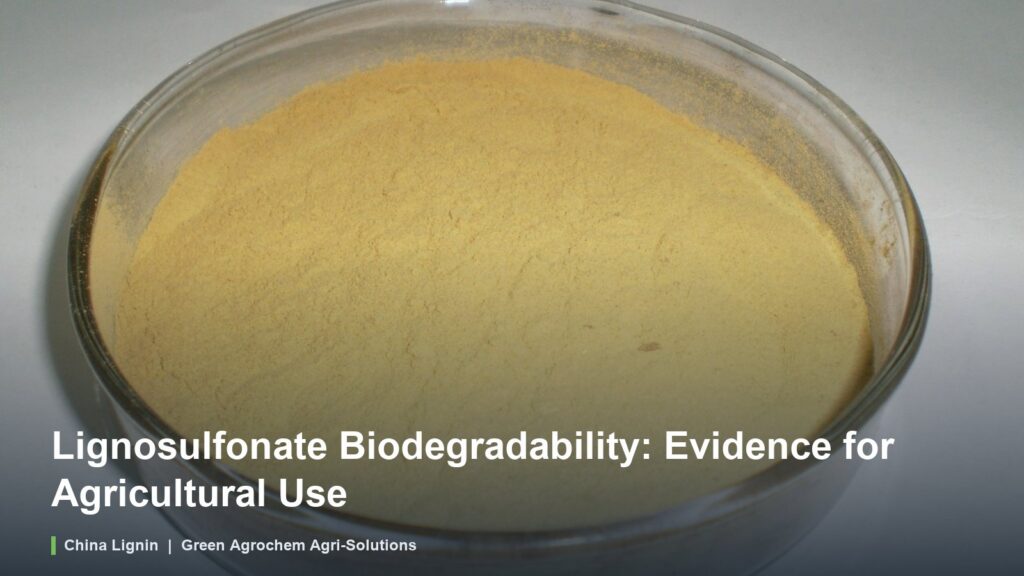
For an agricultural lignosulfonate additive, a biodegradability claim should identify the tested material, test method, endpoint and conditions. Lignin-derived origin and water solubility do not, by themselves, establish how quickly a commercial grade biodegrades or whether a finished formulation is safe for its intended use.
This guide helps fertilizer and crop-input buyers evaluate environmental evidence alongside formulation performance. For application qualification, see the lignosulfonates in agriculture guide and the fertilizer formulation guide.
Separate the claims before comparing products
| Claim | Evidence to request | What it does not establish |
|---|---|---|
| Bio-based origin | Identified raw material and manufacturing information | A biodegradation rate, toxicity result or organic-input approval |
| Water solubility | Defined dissolution or solubility test | Biological breakdown: dissolving is not the same as biodegrading |
| Biodegradability | Report identifying sample, method, measured endpoint and duration | Universal degradation in soil, water and every formulation |
| Lower carbon footprint | Comparable life-cycle assessment with a stated functional unit and boundaries | An advantage based only on the ingredient’s origin |
| Safe agricultural use | Product-specific safety information and assessment of the intended exposure and application | Food, feed or worldwide regulatory permission |
Published test-method numbers: not product performance
The following figures describe a screening framework, not measured results for a Green Agrochem grade. OECD Test No. 301: Ready Biodegradability (1992) covers aerobic aqueous screening methods.
| Method reference | Numerical context | How to interpret it |
|---|---|---|
| Normal test duration | 28 days | A laboratory test period, not a promised field disappearance time |
| DOC-based pass level | 70% dissolved organic carbon removal | A method criterion, not a lignosulfonate test result |
| Respirometric pass level | 60% of theoretical oxygen demand or theoretical carbon dioxide production | A different endpoint from DOC removal; do not combine the percentages |
The OECD overview describes a 10-day window within the 28-day period. Interpretation must follow the selected method’s full validity and timing requirements and the applicable assessment framework. A laboratory should confirm how these apply to the tested material. No exact-grade pass result is asserted here.
Read the complete report, not just the percentage
- Sample identity: match the commercial grade, batch and composition to the material being purchased. A generic lignin sample is not automatically representative of a formulated lignosulfonate product.
- Method and environment: record the exact method, aerobic or anaerobic conditions, medium, inoculum and test duration. Do not treat an aqueous screening result as a field soil study.
- Endpoint: retain the report’s definition of the measured change. Do not relabel disappearance, carbon removal or oxygen uptake as an interchangeable percentage.
- Quality controls: check the laboratory’s validity assessment, blanks, reference material and any stated limitations.
- Conclusion: quote the scope accurately. A result applies to the tested material and conditions, not automatically to another salt, grade or finished mixture.
Qualify agricultural performance separately
Environmental evidence does not replace an application trial. Select a candidate using the calcium lignosulfonate product information or the relevant exact-grade documentation. Confirm its intended function in the fertilizer or crop-input system, then define measurable acceptance criteria.
For a liquid formulation, compare stability, sediment, redispersibility, viscosity and filter behaviour against the existing formulation. For a granulated fertilizer, assess granule strength, attrition, caking and dissolution. Keep raw materials and test conditions comparable. Report the actual addition basis, process and control alongside each result.
Use a supplier-supported starting trial range only when its grade, source and calculation basis are defined. A biodegradability percentage is not a dosage recommendation, and a concrete or animal-feed result is not an agricultural efficacy result.
Keep three evidence layers visible
- Product data: current exact-grade TDS, SDS and batch COA; distinguish typical properties from acceptance specifications.
- Application evidence: supplier starting-trial guidance and controlled formulation results, with their conditions.
- Independent sources: published studies or test standards, clearly separated from the offered product’s own results.
Do not substitute another supplier’s report or a test-method threshold for a missing product result. If a claim cannot yet be substantiated, request the supporting evidence before using it in a purchasing specification or public statement.
Request a documented review
Send the commercial grade, intended agricultural function, destination market and environmental claim you need to substantiate to the agriculture team or info@greenagrochem.com. Specify whether you need a product property, a formulation trial result or an environmental test report so that these distinct questions are not answered with one generic assurance.