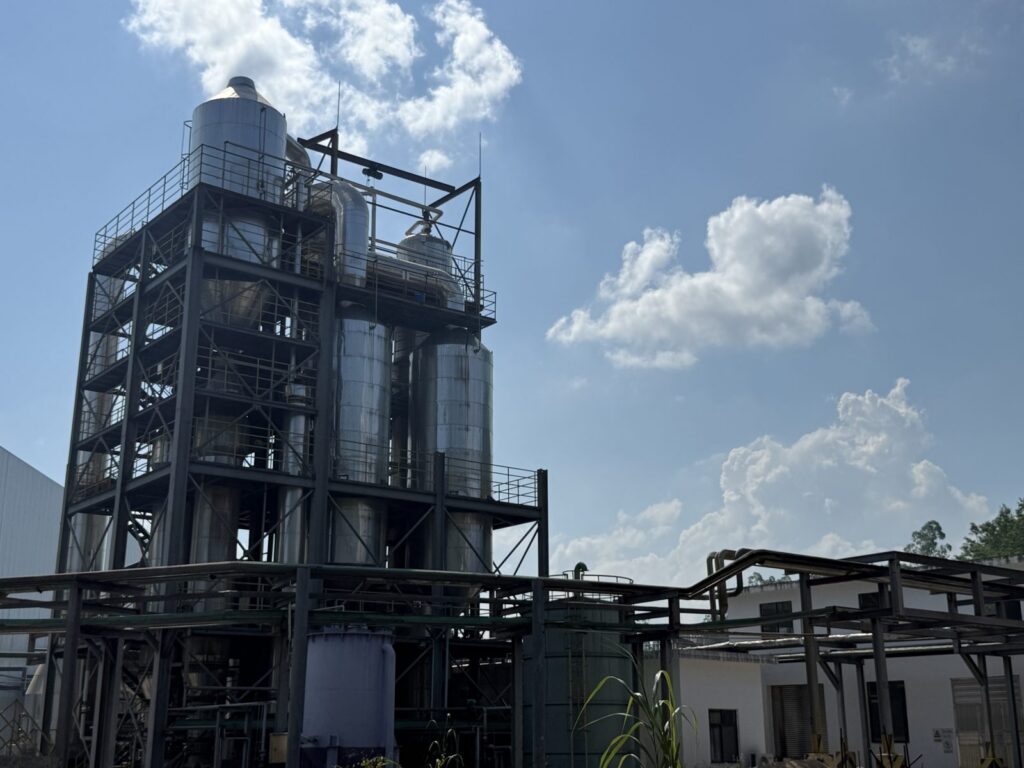
Sodium lignosulfonate can be recovered and refined from lignosulfonate-containing streams associated with sulfite pulping. Understanding that origin helps explain why commercial grades differ, but it does not establish their composition, application dosage or suitability for a particular agricultural formulation.
What happens during sulfite pulping?
During sulfite pulping, lignin is chemically modified and solubilized as cellulose-rich pulp is separated. The resulting spent liquor contains lignosulfonates alongside other dissolved material. It is a process stream, not automatically a finished sodium lignosulfonate grade.
Pulping chemistry and the counterion depend on the process. A calcium- or magnesium-containing liquor should not be described as a sodium product without identifying any subsequent conversion or adjustment. Nor should one cooking temperature, duration or pH range be presented as a universal recipe for all sulfite mills.
From process liquor to a commercial grade
| Stage | What to clarify |
|---|---|
| Separation and clarification | How fibres and suspended process material are removed |
| Recovery and refining | Which sugars, salts and other components remain in the offered grade |
| Counterion or composition adjustment | How the final sodium grade is identified and controlled |
| Concentration | The analytical basis used for the liquid solids content |
| Drying and finishing | Whether the product is supplied as a liquid or dried material; spray drying produces powder, not a liquid concentrate |
| Batch release | The agreed methods, acceptance criteria and lot-specific COA |
These are process areas to verify, not a claim that every supplier uses the same equipment or purification sequence. The separate LigninCorp manufacturing and quality-control guide addresses industrial supplier evaluation.
Sulfite-derived lignosulfonate is not the same as untreated kraft lignin
Kraft lignin and sulfite-derived lignosulfonate come from different pulping routes. Kraft lignin should not be described as inherently sulfur-free. Introducing sulfonate functionality into isolated kraft lignin is a separate modification step; it must not be confused with recovering lignosulfonate from sulfite liquor.
Inwood, Pakzad and Fatehi examined sodium-sulfite modification of softwood kraft lignin in Production of sulfur containing kraft lignin products, BioResources 13(1), 53–70 (2018). Their work distinguishes the starting kraft material from the modified product. It is research evidence for a modification route, not proof that different commercial lignin products are interchangeable or that Green Agrochem uses that experimental process.
Which properties need grade-specific evidence?
Lignosulfonate is a heterogeneous material rather than a single uniform molecule. A representative formula is not a complete specification. Molecular-weight distribution, sulfonation, residual sugars, inorganic components and processing can all matter; higher molecular weight does not automatically mean better dispersion.
- Solubility: state the grade, concentration, water composition, temperature and test procedure. Dissolving in water does not prove compatibility with a fertilizer concentrate.
- Sulfur: distinguish total sulfur from sulfate and organically bound sulfur. They are not interchangeable reporting quantities.
- Thermal behaviour: a laboratory thermal-analysis result does not establish a universal service temperature or downhole performance.
- Content and solids: distinguish lignosulfonate content from total dry matter, with the analytical basis and method stated.
For neutral chemistry, see why sodium lignosulfonate has no single molecular formula. For purchasing, use the exact grade’s current TDS, SDS and batch COA rather than a generic property table.
What the origin means for agricultural evaluation
A sulfite-derived origin does not prove soil improvement, crop safety, organic eligibility or complete biodegradation. Establish the intended formulation role, then test the actual material. Fertilizer granulation requires different acceptance tests from suspension dispersion or crop response.
The fertilizer qualification guide covers application testing, while the biodegradability evidence guide explains environmental-claim requirements. Construction water reduction, feed binding and road dust control must not be used as agricultural performance guarantees.
Questions to send with a sample enquiry
Ask for the material’s commercial identity, production-route description, counterion, document revision and lot traceability. Describe your formulation, process water, required function and acceptance tests. Request any starting trial guidance with its exact grade and calculation basis. Contact info@greenagrochem.com for the relevant document set.