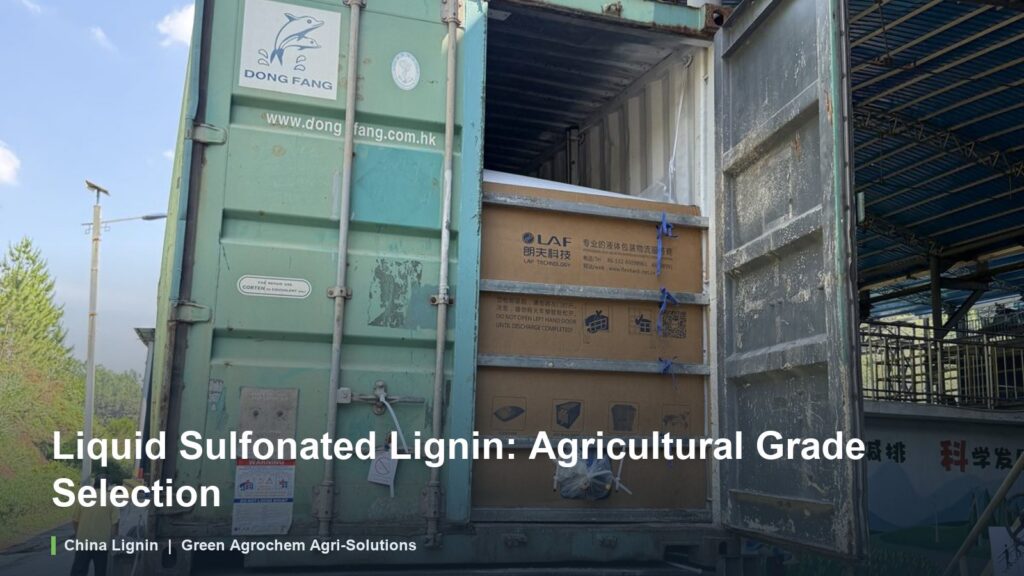
“Liquid sulfonated lignin” is not a complete purchasing specification. Before selecting a liquid material for an agricultural formulation, identify the commercial grade, counter-ion, manufacturing description and analytical basis. A shared trade description does not establish that two products are interchangeable.
This guide addresses material identification and grade selection. For stock preparation and dilution arithmetic, use the separate sodium lignosulphonate solution guide. For application trials, see liquid lignosulfonate in agriculture.
Clarify the material behind the name
Ask the supplier to state whether the offered material is a lignosulfonate from sulfite pulping or another lignin-derived material that has undergone further chemical modification. Record the actual product identity rather than assigning a production route from its colour or trade name. A sodium grade should not be substituted for a calcium, potassium or other grade without reviewing the complete formulation.
| Item to identify | Question for the supplier | Purchasing consequence |
|---|---|---|
| Commercial identity | What product code and revision describe the offered material? | Connect the sample, quotation and delivered lot to the same grade. |
| Salt form and composition | Which counter-ion, carriers and other ingredients are present? | Review the contribution of the whole supplied material to the formulation. |
| Liquid form | Is the material a concentrate or a prepared dilution? | Compare deliveries on a defined analytical basis, not colour or volume alone. |
| Intended application | What documentation supports agricultural formulation evaluation? | Do not infer crop suitability from a construction or dust-control application. |
Read solids, active content and density separately
Total dry solids, lignosulfonate content and a supplier-defined active fraction are different reporting items. Request their definitions and methods before using them to compare quotations. Confirm whether a percentage describes the as-supplied liquid or its dry matter.
Density needs a unit and measurement temperature. pH needs its test dilution or as-supplied basis. Viscosity needs temperature and measurement conditions. A value without these details may be unsuitable for comparing grades or designing a dosing system.
| Document | What to check |
|---|---|
| Current TDS | Exact grade, revision, property definitions, typical values versus agreed limits, and application scope. |
| Product-specific SDS | Identity and handling information for the supplied material; do not substitute a sheet for another grade. |
| Actual shipment COA | Lot identity, measured results, units and methods. A blank or illustrative template is not a shipment test. |
| Application guidance | Supported trial range, addition basis, intended formulation and validation conditions. |
If descriptions and tables conflict, obtain a corrected document before calculating a production addition. Do not average conflicting figures. This article does not assign a universal solids content, pH range or dosage to all liquids sold under this name.
Choose a grade against the agricultural formulation
Start with the required function: dispersion in a mineral suspension, binding in fertilizer granulation, or another clearly defined formulation role. Use the sodium lignosulfonate product information to begin a grade enquiry, then qualify the selected liquid with its own documents.
- For liquid formulations, compare settling, redispersibility, precipitation, viscosity and filter behaviour using the actual fertilizer salts and process water.
- For granulation, assess drying, granule strength, attrition, caking and dissolution independently of liquid appearance.
- Record storage conditions, mixing sequence and the control formulation so a successful trial can be reproduced.
- Assess crop performance separately from mixing or processing performance; a stable formulation is not proof of yield improvement.
The fertilizer qualification guide provides the wider evaluation workflow. Use a numerical starting trial range only when the exact grade, document and mass or volume basis are identified.
Keep industrial and environmental claims in scope
Concrete water reduction, road binding and ceramic processing results should not become agricultural performance promises. Industrial buyers can use LigninCorp’s liquid sodium lignosulfonate product route for the appropriate purchasing discussion.
Do not infer universal safety, feed suitability or organic-input eligibility from a lignin-derived origin. Environmental claims also require their own evidence; see how to evaluate lignosulfonate biodegradability evidence.
Request a comparable quotation and sample
Send the intended function, formulation type, required delivery form, process-water information, acceptance tests, quantity and destination to the agriculture team or info@greenagrochem.com. Ask for an identified sample and document set before comparing price. Compare usable material and validated processing performance, not merely the price of a litre of brown liquid.
What Is Sulfonated Lignin?
Lignin in wood is not soluble in water. Sulfonation attaches sulfonate groups to the lignin, which makes it water-soluble and negatively charged. There are two main routes:
| Route | How it works | Product |
|---|---|---|
| Sulfite pulping | Wood is cooked with a sulfite solution; the lignin is sulfonated as it is removed from the fibre | Lignosulfonates (sodium, calcium, magnesium, ammonium, potassium) |
| Sulfomethylation of kraft lignin | Lignin recovered from kraft pulping is reacted to add sulfonate groups | Sulfonated kraft lignin |
Our liquid products are lignosulfonates from the sulfite route. In agriculture the term “sulfonated lignin” is often used for the same materials.
Liquid Grades for Agriculture
| Grade (code) | Solids | Lignosulphonate (dry basis) | pH | Nutrient |
|---|---|---|---|---|
| Sodium Grade One (GAC-NaLS-L) | 45% min | 50% min | 7.0 – 11.0 | — |
| Potassium (GAC-KLS-L) | 45% min | 45% min | 4.0 – 7.0 | K₂O 8 – 10% |
| Ammonium fertilizer grade (GAC-NHLS-FERT) | 50% min | 50% min | 4.0 – 7.0 | N 3 – 5% |
| Ammonium acidic (GAC-NHLS-L-ACD) | 45% min | 50% min | 4.0 – 6.0 | N 3 – 5% |
| Ammonium alkaline (GAC-NHLS-L-ALK) | 45% min | 50% min | 8.0 – 10.0 | N 3 – 5% |
Converting Between Liquid and Dry
Formulation recipes usually state dry lignosulfonate. For a 45% solids liquid, 1 kg of dry lignosulfonate equals about 2.22 kg of liquid, and the liquid brings about 1.22 kg of water into the batch. Use the solids from the batch COA.
Frequently Asked Questions
What is sulfonated lignin?
Lignin that carries sulfonate groups, which make it water-soluble. Lignosulfonates from sulfite pulping are the main type.
How is lignin sulfonated?
Mainly during sulfite pulping, where the cooking liquor sulfonates the lignin. Kraft lignin can also be sulfonated afterwards (sulfomethylation).
Is liquid lignin the same as liquid lignosulfonate?
Products sold as “liquid lignin” are normally lignosulfonate solutions, because native lignin does not dissolve in water.
Which liquid sulfonated lignin is used in fertilizers?
Sodium, potassium and ammonium lignosulfonates. Potassium and ammonium grades also supply K₂O or nitrogen.